
GEOGRAPHY OF SPANISH FASHION
CANDY PRATTS PRICE · JUAN GATTI · ACME
THE ADVICE BECAME A CULTURAL PROJECT.
The work in New York had already changed the conversation around Spanish fashion.
The meeting with Anna Wintour had produced something more valuable than visibility: a roadmap.
Her closing message was unequivocal:
“I HIGHLY RECOMMEND THAT YOU FOLLOW MY ADVICE.”
That advice led to a deeper relationship with Condé Nast and to the involvement of Candy Pratts Price as an international editorial advisor to the programme.
What had started as market access was now beginning to influence how Spanish fashion understood and presented itself internationally.
[VISUAL 1]
THE QUESTION BECAME BIGGER THAN FASHION.
The anniversary of Madrid Fashion Week created the opportunity for a new project.
But simply celebrating its history was not enough.
The ambition became much broader:
What could contemporary Spanish fashion say about Spain itself?
Geography of Spanish Fashion was conceived as a way of placing designers inside a wider cultural landscape, connecting fashion with the images, references and identities that surrounded it.
[VISUAL 2]
AN INTERNATIONAL EYE. A SPANISH VISUAL LANGUAGE.
Candy Pratts Price brought the international editorial perspective that had emerged from the New York strategy.
Juan Gatti shaped the project’s visual language.
Together, that combination moved the project away from the logic of a conventional fashion catalogue.
Designers were not presented in isolation.
Fashion was connected with photography, art, heritage, image and identity, creating a broader reading of Spanish contemporary culture.
THE COUNTRY BECAME PART OF THE STORY.
The project looked at Spanish fashion not simply as a group of designers or a sequence of collections.
It explored the cultural territory around them.
Spain became part of the narrative.
Its visual references, creative traditions, contradictions and contemporary identity provided a context in which fashion could be read differently.
The objective was no longer simply to show Spanish fashion abroad.
It was to help define what Spanish fashion could mean internationally.
[VISUAL 4]
FROM ACCESS TO INTERPRETATION.
The earlier projects had created visibility.
New York had created access.
Anna Wintour had provided direction.
Candy Pratts Price helped translate that direction into an international editorial perspective.
Geography of Spanish Fashion took the next step:
turning fashion into cultural narrative.
The project transformed an anniversary into a positioning platform and connected the designers to something larger than the industry itself.
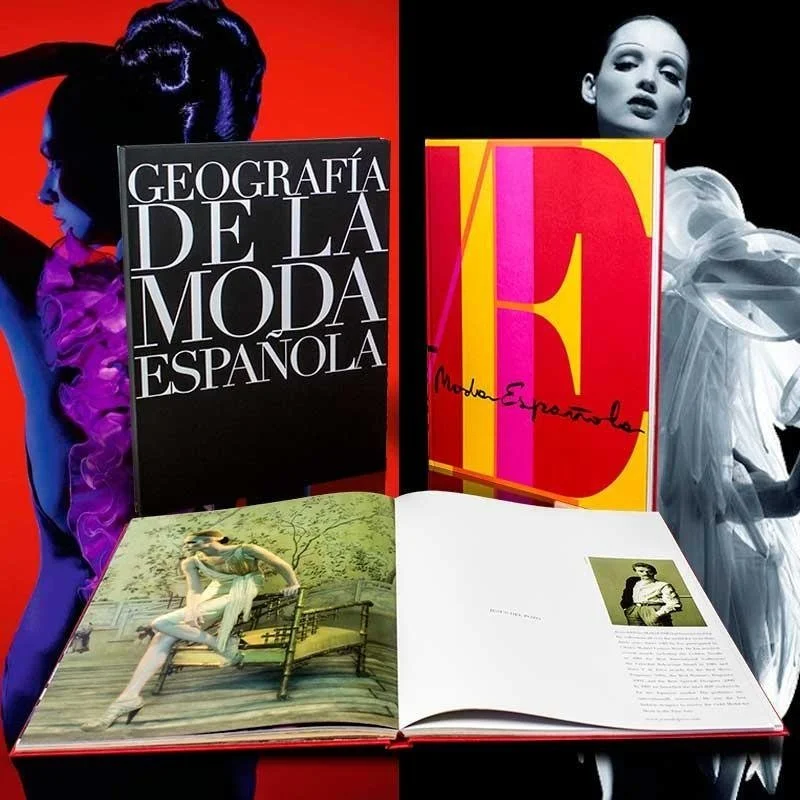
[VISUAL 5 / BOOK DETAILS OR FINAL SPREAD]
IDENTITY BECAME POSITIONING.
By this point, the ACME programme was no longer only about gaining access to the international fashion system.
It was also about shaping the way Spanish fashion could be understood within it.
Geography of Spanish Fashion made that shift visible.
From designers to culture.
From visibility to meaning.
From fashion to identity.
And once again, one relationship had created the conditions for the next.